Wednesday, November 21, 2007
Meet my Daemon, Boreallus
If you haven't read the "His Dark Materials" book by Philip Pullman, run, don't walk to your nearest bookstore and read them. The movie of the first book, "The Golden Compass," comes out this Christmas.


Sunday, November 11, 2007
A Different Kind of Protest for Burma
Send your undies in protest to the Embassy at:
Embassy of the Union of Myanmar
2300 S Street NW
Washington D.C., 20008
Hattip, Jillan.
Sunday, November 04, 2007
BOO!

Tanna Kohime, Halloween Maze.
Snapshot by EldertaHallo! OK, it's been a few weeks, and I missed Halloween, but really, I've had nothing to say, so I've said nothing. Plus, I was preparing to leave my job and I was helleva busy. So now here I am with a teeny teeny tiny update. Plus, the world is as it was two weeks ago: cccrraaazzzzyyyy!
Good news! I got a new J.O.B.! And I cleaned and rearranged my room. Egads, productivity galore! I start tomorrow and I'm very very very happy about this job and that I have a clean, rearranged, room. Woohoo!!
Just a few seconds ago, I saw the first commercial for the film, His Dark Materials: The Golden Compass. If you haven't read this trilogy of books by Philip Pullman, I recommend that you run, don't walk to your nearest bookstore, take a turn in the young adult section, and get these books. I hope the film is as good as the book, but I completely doubt that's going to happen. I'll see them, but I'm sure there are arguments already brewing among geeks and hardcore fans.
I watched Saturday Night Live yesterday, and last night's host, Brian Williams was actually funny in a few places. The Weekend Update was hysterical, and Barack Obama showed up in the opening skit, completely unexpected. All in all, a good "shew," which is saying a lot for any of the SNLs these days.
In less entertainment-related news, I read that there have been small protests in Burma, led by monks and new protests may be led by farmers soon. Nothing large, but they still sprout up and continue. The country is about to sell off a bunch of rubies, which is a bi-yearly mainstay of the economy. Human rights advocates are requesting a boycott of buyers at the sale. Boycotts have a shaky track record, so we'll see if it actually pans out. Unfortunately, it's just been announced that the UN representative, Charles Petrie, has been booted out of Myanmar. He was a little too truthful when his office released a statement regarding Burma's recent protests, which were spurred by a sudden spike in the price of fuel, when he said that these "events clearly demonstrated the everyday struggle to meet basic needs, and the urgent necessity to address the deteriorating humanitarian situation in the country. These are the same messages that the United Nations Country Team in Myanmar has been endeavouring to bring to the Government’s attention for some time."
Good luck with bringing that to their attention. Apparently they have not gotten the message and continue to blame the unrest on "outside foreign operatives." I guess that would be someone like me, but I wouldn't want to think that I had anything to do with people wanting better and more humane conditions in their every day lives. Buddha forbid.
The Congress is still playing around with torture, and my Senator... not Hillary... the other one, Chuck, caved in and, along with Dianne Feinstein, let the new nominee for Attorney General, Michael Mukasey get out of committee, even though he wouldn't firmly call waterboarding torture. Mukasey is a blowhard from the Bronx, and though his nomination was originally touted as a breakthrough in the Justice Department, once he started hemming and hawing about waterboarding, his lights went down in Saneville and his stats shot up in Crazytown. No, I don't have statistics to present to you. Sorry. Of course, Chuck thought him a wonderful candidate and couldn't say no to him after praising him to the high heavens.
Chuck: I'm not voting for you again. Cheers.
I won't even go into all the hissy fits that President Bush has been having on live teevee lately. Really, they are about as juvenile as a president can get without crawling around in a diaper in the Oval Office.
OK, that's about it for me. It's already 11:30, and I have a new job to start tomorrow.
Wish me luck!
And I wish you luck, too!
Sunday, October 21, 2007
Just Call Me Paranoid
Why can't I get to this NYT article about Myamnar?
Of course, it's 'probably' a slow Internet connection.
Or it could be the time of the night.
Or maybe some ad waiting to be annoyingly loaded.
Or it could be deliberate.
OK, it's back now.
In this day and age, you have to ask the question.
Of course, it's 'probably' a slow Internet connection.
Or it could be the time of the night.
Or maybe some ad waiting to be annoyingly loaded.
Or it could be deliberate.
OK, it's back now.
In this day and age, you have to ask the question.
They Clap for Freedom
From the New York Times
Lives
Through Myanmar Darkly
By CHARLES LONDON
Published: October 21, 2007
Read More
Lives
Through Myanmar Darkly
By CHARLES LONDON
Published: October 21, 2007
By that rainy Saturday, my last day in the country, I couldn’t help but follow the three young monks as they wove through the downtown crowds. I saw another group hop off a bus, sloshing through puddles, also walking intently to Sule Pagoda. I noticed a crowd forming outside the temple. I joined it. Behind me, the police at City Hall unlocked the barbed-wire gate there. They started the engine of a jeep, but no one in the crowd took notice.--Charles London, a former research associate for Refugees International, is the author of “One Day the Soldiers Came: Voices of Children in War.”Suddenly, 500 monks emerged in rows four across. They carried flags and overturned alms bowls. When the first group stopped and chanted a prayer, some people in the crowd dared to clap. It was timid at first, but as more monks emerged to begin their protest, the clapping grew louder until the whole crowd seemed overcome by it. A Burmese man leaned toward me. “They have never done this before,” he said. “They clap for freedom.” The faces in the crowd were excited, part bliss, part terror.
Read More
Thursday, October 18, 2007
LOLCAT Bible
Thus spoke Ceiling Cat:
 An Internet friend, Not_Over_It, found this amazing new Wiki version of the Bible... in LOLCAT language!
You can find the LOLCAT Bible here, and they are also looking for people to help translate the Bible as well, particularly the New Testament.
If you don't know the LOLCATs, then you don't know what fun you're missing.
Ceiling Cat looks down at his Creation.
Oh hai. In teh beginnin Ceiling Cat waz invisible, An he maded the skiez An da Urf, but he no eated it.
Genesis 1:1
LOLCAT Bible
An Internet friend, Not_Over_It, found this amazing new Wiki version of the Bible... in LOLCAT language!You can find the LOLCAT Bible here, and they are also looking for people to help translate the Bible as well, particularly the New Testament.
If you don't know the LOLCATs, then you don't know what fun you're missing.
Ceiling Cat looks down at his Creation.
Sunday, October 14, 2007
A Common Word Between Us
Interesting letter written by top Muslim clerics to their Christian counterparts.
Read about it here.
Read about it here.
Sunday, October 07, 2007
This is America?
 America is amazing; completely head-'explodingly' amazing. With all the crap going on in the world these days, the only thing that people are concerned over is whether Barack Obama wears an American flag lapel pin or not. Unfrickingbelievable. I thought we were America, land of the free; free to be individuals, not pin-wearing automatons.
Why is it that in America the depth of one's patriotism is measured by whether a pin is attached to one's lapel? Can this be any more of a false whine that has ever left the lips of a right-wing operative? Is this really the measure of how much or how little an American can love his country? Is a lapel pin really the measure of a man's soul?
An Internet friend sent me a link to a William Rivers Pitt column at Truth Out, in which Pitt believes he may have developed a touch of the insane from the way that Republicans have successfully warped reality. I would like to tell him that he has not gone insane. The Republicans who are worried about this shit as well as Republicans who still shill for this administration, are the insane one and they have lost their fucking minds. And nothing, and I mean nothing, will bring them back to sanity. Why? Because they do not want to think clearly, they have created their own reality, and yes, it's backwards, opposite land. They are lost in their own need to win, to control, and be part of the "in" crowd of patriotic, hyper-American lapel pin wearers.
I declare that Obama is my candidate. He doesn't have to wear an American flag or yellow ribbon pin to prove to me that he loves his country or supports the troops. It's actions that count, not canned rhetoric. And if anyone needs that symbolism in order for him or her to love their country, it's a hollow, false and dead patriotism that I do not want and do not need.
Monday, October 01, 2007
Peaceful Protest Can Lead to This

Almost makes you think that an armed population is better than an unarmed one.
Please sign this petition. It's the least we can do.
Thursday, September 27, 2007
Burma and the Monks
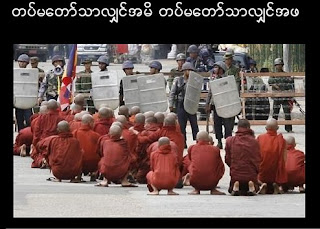 Click on the picture for a current blog on the Burmese uprising of 2007.
 This picture pretty much sums up what I love about Buddhism, particularly Mahayana Buddhism (The Burmese practice Theravada Buddhism but while some things are different, the basics are the same.) These monks are using peaceful prayer and ritual as their protest in the face of their enemies. Several monks (and a Japanese journalist) lost their lives today because of it. In Buddhism, enemies may have guns pointed at you, but a Buddhist sees no enemy, only a being who needs compassion. Buddha has given these monks the strength to become bodhisattavas, humans made divine by suffering for the benefit of all.
It's hard to live up to and takes great patience and an open heart through all obstacles that comes one's way. I certainly hope that these kind monks help free their people and restore the democracy the people of Myanmar voted on but was denied. Good luck, Burma.
All who comprise the great assemblage of Bodhisattvas are equally powerful and equally beneficial to countless beings, so that all things seem to be at their command. Sometimes beautiful lotuses and lotus trees are caused by them to grow from the middle of the ocean, or a teardrop is transformed into an ocean. Everything in nature is at the Bodhisattva's call. Fire can appear as water; water can appear as fire. It is all because of the strength of the Bodhisattva's attitude, the aspiration and action. For us this says that the practice of compassion must be given full consideration, and it must at all times be in our awareness and at all times performed."
~ 16th Karmapa Rangjung Rigpe Dorje, teaching on Compassion. (Extract of article in I K H newsletter at Ngawang Geleg's site.)
Tuesday, September 25, 2007

Saturday, September 22, 2007
Privatize Everything!
America's New Army - Can you live with it?
Blackwater USA
Blackwater USA - Wikipedia
Democracy Now
Sourcewatch
Corpwatch
Iraq For Sale - Blackwater
Hattip list, Rare!
The Age of Irresponsibility - Newsweek - Michael Hirsh
U.S. Repeatedly Rebuffed Iraq on Blackwater Complaints - Washington Post
Top Ten PR Moves for Blackwater - Danger Room Blog; Wired
Iraq Limits Blackwater's Operations - Time - Adam Zagorin and Brian Bennett
Iraqi PM disputes Blackwater's Version - USA Today


Blackwater accused of Illegally Smuggling Weapons Into Iraq - CNN/Youtube
A different view
Warriors for Hire - Weekly Standard
Iraq Reviewing Security Firms After Blackwater Shooting
Blackwater Blackballed - Captain's Quarters Blog
Just asking.
And yes, I remember this.
Blackwater USA
Blackwater USA - Wikipedia
Democracy Now
Sourcewatch
Corpwatch
Iraq For Sale - Blackwater
Hattip list, Rare!
The Age of Irresponsibility - Newsweek - Michael Hirsh
U.S. Repeatedly Rebuffed Iraq on Blackwater Complaints - Washington Post
Top Ten PR Moves for Blackwater - Danger Room Blog; Wired
Iraq Limits Blackwater's Operations - Time - Adam Zagorin and Brian Bennett
Iraqi PM disputes Blackwater's Version - USA Today
Blackwater accused of Illegally Smuggling Weapons Into Iraq - CNN/Youtube
A different view
Warriors for Hire - Weekly Standard
Iraq Reviewing Security Firms After Blackwater Shooting
Blackwater Blackballed - Captain's Quarters Blog
Just asking.
And yes, I remember this.
Friday, September 21, 2007

Thursday, September 20, 2007
You Have Got To Be Kidding Me
Today I got an email saying that the Senate was going to vote on a resolution condemning MoveOn.org for wordplaying on Petraeus' last name and replacing it with Betray-Us. I couldn't believe what I was reading, particularly the day AFTER the Senate couldn't pass a bill to mandate equal time on and off the battlefield for soldiers and couldn't muster up the courage to restore habeaus corpus, too.
By a vote of 72-25, with 3 not voting (including Obama and Biden), the Senate condemned an advertisement or, more specifically, they voted to...
God help us all. It's gotten just one more step scarier out here.
By a vote of 72-25, with 3 not voting (including Obama and Biden), the Senate condemned an advertisement or, more specifically, they voted to...
...express the sense of the Senate that General David H. Petraeus, Commanding General, Multi-National Force-Iraq, deserves the full support of the Senate and strongly condemn personal attacks on the honor and integrity of General Petraeus and all members of the United States Armed Forces.It's ok, however, for Republicans to do and say and advertise all sort of things. Here's a nice little list from Paul Begala, of all people:
* In the 2000 South Carolina primary, George W. Bush stood next to a man described as a "fringe" figure - a man who had attacked Bush's own father - at a Bush rally. With Bush applauding him, the man said John McCain "abandoned" veterans. McCain, who was tortured in a North Vietnamese POW camp, was incensed. Five U.S. Senators who fought in Vietnam, including Democrats John Kerry, Max Cleland and Bob Kerrey, condemned the attack and called on Bush to repudiate it. When pressed on it at a debate hosted by CNN's Larry King, Bush meekly muttered that he shouldn't be held responsible for what others say. Even when he's standing next to them at a Bush rally.This entire episode is unbelievable. It's ok for organizations such as "Gathering of Eagles" to spew all sorts of hateful speech against "moonbats" and "libruls" and the fathers of dead soldiers who say that they were beaten by members of that organization, but say the term "Betray-Us" and the right goes so far as to pass a resolution in the Senate of all places. Give me a freaking break.
* In the 2002 campaign, draft dodger Saxby Chambliss ran an ad with pictures of Osama bin Laden and Saddam Hussein, then said Sen. Max Cleland lacked courage. Max Cleland left three limbs in Vietnam as an Army captain. Mr. Bush's political aide, Karl Rove, later refused to disavow the ad, saying, "President Bush and the White House don't write the ads for Senate candidates."
* Also in the 2002 campaign, the PAC for the Family Research Council, a close Bush ally, ran an ad in South Dakota that pictured Sen. Tom Daschle and Saddam Hussein. "What do Saddam Hussein and Senate Majority Leader Tom Daschle have in common?" the ad asked. Apparently, they both opposed drilling in the Arctic wilderness. First, I had no idea that supporting drilling in the wilderness is a family values issue. Second, I have seen no reporting on the late Iraqi dictator's position on Alaska drilling. But I do know Tom Daschle is an Air Force veteran. Mr. Bush never disavowed the smear.
* But perhaps the worst was what was done to John Kerry. Kerry earned five major medals in combat: the Silver Star, the Bronze Star and three Purple Hearts. And yet supporters of Bush and Cheney decided to smear his war record. The despicable, dishonest Swift Boat attacks alleged that Kerry fabricated reports that earned him the Bronze Star. The Swifties also suggested that Kerry's wounds were insignificant - and that one was even self-inflicted. Kerry's wounds were certainly more serious than Mr. Bush's, who suffered a cut on his finger from popping a beer can while avoiding his duty in the Alabama National Guard. At the 2000 GOP convention, rich, white Republicans were photographed gleefully putting Band-Aids with purple hearts on their chubby cheeks. Mr. Bush refused to condemn the attack - blandly noting he didn't like 527 groups generally - and later nominated one of the men who financed the smear to be Ambassador to Belgium.
God help us all. It's gotten just one more step scarier out here.
Tuesday, September 18, 2007
The End of Times Select
If you haven't heard yet, the New York Times will lay to rest their failed experiment of containing some content, including their Op-ed writers, behind the Times Select subscription firewall. I stole this photograph from Crooks and Liars, but really, it's my sentiments exactlY:


Sunday, September 16, 2007
Hagel on Petraeus Report
Maher: Isn’t a dirty trick on the American people when you send a military man out there to basically do a political sell-job?”
Hagel: It’s not only a dirty trick, but it’s dishonest, it’s hypocritical, it’s dangerous and irresponsible. The fact is this is not Petraeus’ policy, it’s the Bush’s policy. The military is — certainly very clear in the Constitution — is subservient to the elected public officials of this country.. but to put our military in a position that this administration has put them in is just wrong, and it’s dangerous.”
Kinda puts the Move On ad into a whole new light. The light that Move On wanted to shed before outrage set in over a hard-hitting headline.
Over-the-Top Alert #7,322
I had to chuckle earlier this week when Republicans and Democrats alike went ballistic over MoveOn making a play on General Petreaus' last name in the catching pun, "General Betray Us"
Since Bush came into office there has been a steady stream of invective thrown at "libruls." It's been a verbal slugfest between both parties, actually, and the language is only going to ratchet up as time and Bush's term... uh... moves on. The Move On added fuel to the fire because it's directed at a soldier. Since Vietnam, which had legends and real problems of citizens maligning soldiers, we tend to steer away from harsh verbal criticism of our military.
Whether one agrees with the Move On ad or not, they did present facts to back up their claim. They created a headline (which Randi Rhodes of Air America has claimed began with her) and they ran with it. However, the ad's headline has overshadowed the actual information that they wanted to bring out, and that is quite unfortunate.
Republicans went completely ballistic over Move On's ad, and every Democrat that has been paraded on the teevee lately has had to answer for the ad, usually in the form of adamant disavowals. As I'm writing this, Blitzer is asking Sen. Evan Bayh if Democrats should accept money from Move On now, as Sen. Cornyn says it's abominable for Move On to be accusing Petreaus of treason. Where did treason come from??? As the soldiers in the NYT op-ed said, the political debate in this country is "surreal."
I don't know where all this language is going, but really, I don't think it's going to be a happy, fun, and fluffy place.
Since Bush came into office there has been a steady stream of invective thrown at "libruls." It's been a verbal slugfest between both parties, actually, and the language is only going to ratchet up as time and Bush's term... uh... moves on. The Move On added fuel to the fire because it's directed at a soldier. Since Vietnam, which had legends and real problems of citizens maligning soldiers, we tend to steer away from harsh verbal criticism of our military.
Whether one agrees with the Move On ad or not, they did present facts to back up their claim. They created a headline (which Randi Rhodes of Air America has claimed began with her) and they ran with it. However, the ad's headline has overshadowed the actual information that they wanted to bring out, and that is quite unfortunate.
Republicans went completely ballistic over Move On's ad, and every Democrat that has been paraded on the teevee lately has had to answer for the ad, usually in the form of adamant disavowals. As I'm writing this, Blitzer is asking Sen. Evan Bayh if Democrats should accept money from Move On now, as Sen. Cornyn says it's abominable for Move On to be accusing Petreaus of treason. Where did treason come from??? As the soldiers in the NYT op-ed said, the political debate in this country is "surreal."
I don't know where all this language is going, but really, I don't think it's going to be a happy, fun, and fluffy place.
Wednesday, September 12, 2007
The War As We Saw It (The War As It Is)
This New York Times Op-Ed was published on August 19, 2007 and written by seven current duty soldiers serving in Iraq. I'm not sure if many people saw this Op-Ed, but I did. At the time it was being written, one of the soldiers, Staff Sgt. Jeremy Murphy, was shot in the head but recovered. Today, it was reported that two of the sergeants, Sgt. Omar Mora and Sgt. Yance T. Gray, were killed as the truck they were riding in fell off of an elevated highway in Western Baghdad into a 30-foot ravine.
I will offer no "thanks for your service." These men did not ask me for that. What they asked of me as an American is to think logically about this war and to change our current course. It saddens me to great end that two of these brave men have lost their lives. First, they were brave for serving, and they were brave for speaking out. My condolences to their families.
Here, whether the NYT cares or not, I post their op-ed because you need to read it.
I will offer no "thanks for your service." These men did not ask me for that. What they asked of me as an American is to think logically about this war and to change our current course. It saddens me to great end that two of these brave men have lost their lives. First, they were brave for serving, and they were brave for speaking out. My condolences to their families.
Here, whether the NYT cares or not, I post their op-ed because you need to read it.
Op-Ed Contributors
The War as We Saw It
By BUDDHIKA JAYAMAHA, WESLEY D. SMITH, JEREMY ROEBUCK, OMAR MORA, EDWARD SANDMEIER, YANCE T. GRAY and JEREMY A. MURPHY
Baghdad
VIEWED from Iraq at the tail end of a 15-month deployment, the political debate in Washington is indeed surreal. Counterinsurgency is, by definition, a competition between insurgents and counterinsurgents for the control and support of a population. To believe that Americans, with an occupying force that long ago outlived its reluctant welcome, can win over a recalcitrant local population and win this counterinsurgency is far-fetched. As responsible infantrymen and noncommissioned officers with the 82nd Airborne Division soon heading back home, we are skeptical of recent press coverage portraying the conflict as increasingly manageable and feel it has neglected the mounting civil, political and social unrest we see every day. (Obviously, these are our personal views and should not be seen as official within our chain of command.)
The claim that we are increasingly in control of the battlefields in Iraq is an assessment arrived at through a flawed, American-centered framework. Yes, we are militarily superior, but our successes are offset by failures elsewhere. What soldiers call the “battle space” remains the same, with changes only at the margins. It is crowded with actors who do not fit neatly into boxes: Sunni extremists, Al Qaeda terrorists, Shiite militiamen, criminals and armed tribes. This situation is made more complex by the questionable loyalties and Janus-faced role of the Iraqi police and Iraqi Army, which have been trained and armed at United States taxpayers’ expense.
A few nights ago, for example, we witnessed the death of one American soldier and the critical wounding of two others when a lethal armor-piercing explosive was detonated between an Iraqi Army checkpoint and a police one. Local Iraqis readily testified to American investigators that Iraqi police and Army officers escorted the triggermen and helped plant the bomb. These civilians highlighted their own predicament: had they informed the Americans of the bomb before the incident, the Iraqi Army, the police or the local Shiite militia would have killed their families.
As many grunts will tell you, this is a near-routine event. Reports that a majority of Iraqi Army commanders are now reliable partners can be considered only misleading rhetoric. The truth is that battalion commanders, even if well meaning, have little to no influence over the thousands of obstinate men under them, in an incoherent chain of command, who are really loyal only to their militias.
Similarly, Sunnis, who have been underrepresented in the new Iraqi armed forces, now find themselves forming militias, sometimes with our tacit support. Sunnis recognize that the best guarantee they may have against Shiite militias and the Shiite-dominated government is to form their own armed bands. We arm them to aid in our fight against Al Qaeda.
However, while creating proxies is essential in winning a counterinsurgency, it requires that the proxies are loyal to the center that we claim to support. Armed Sunni tribes have indeed become effective surrogates, but the enduring question is where their loyalties would lie in our absence. The Iraqi government finds itself working at cross purposes with us on this issue because it is justifiably fearful that Sunni militias will turn on it should the Americans leave.
In short, we operate in a bewildering context of determined enemies and questionable allies, one where the balance of forces on the ground remains entirely unclear. (In the course of writing this article, this fact became all too clear: one of us, Staff Sergeant Murphy, an Army Ranger and reconnaissance team leader, was shot in the head during a “time-sensitive target acquisition mission” on Aug. 12; he is expected to survive and is being flown to a military hospital in the United States.) While we have the will and the resources to fight in this context, we are effectively hamstrung because realities on the ground require measures we will always refuse — namely, the widespread use of lethal and brutal force.
Given the situation, it is important not to assess security from an American-centered perspective. The ability of, say, American observers to safely walk down the streets of formerly violent towns is not a resounding indicator of security. What matters is the experience of the local citizenry and the future of our counterinsurgency. When we take this view, we see that a vast majority of Iraqis feel increasingly insecure and view us as an occupation force that has failed to produce normalcy after four years and is increasingly unlikely to do so as we continue to arm each warring side.
Coupling our military strategy to an insistence that the Iraqis meet political benchmarks for reconciliation is also unhelpful. The morass in the government has fueled impatience and confusion while providing no semblance of security to average Iraqis. Leaders are far from arriving at a lasting political settlement. This should not be surprising, since a lasting political solution will not be possible while the military situation remains in constant flux.
The Iraqi government is run by the main coalition partners of the Shiite-dominated United Iraqi Alliance, with Kurds as minority members. The Shiite clerical establishment formed the alliance to make sure its people did not succumb to the same mistake as in 1920: rebelling against the occupying Western force (then the British) and losing what they believed was their inherent right to rule Iraq as the majority. The qualified and reluctant welcome we received from the Shiites since the invasion has to be seen in that historical context. They saw in us something useful for the moment.
Now that moment is passing, as the Shiites have achieved what they believe is rightfully theirs. Their next task is to figure out how best to consolidate the gains, because reconciliation without consolidation risks losing it all. Washington’s insistence that the Iraqis correct the three gravest mistakes we made — de-Baathification, the dismantling of the Iraqi Army and the creation of a loose federalist system of government — places us at cross purposes with the government we have committed to support.
Political reconciliation in Iraq will occur, but not at our insistence or in ways that meet our benchmarks. It will happen on Iraqi terms when the reality on the battlefield is congruent with that in the political sphere. There will be no magnanimous solutions that please every party the way we expect, and there will be winners and losers. The choice we have left is to decide which side we will take. Trying to please every party in the conflict — as we do now — will only ensure we are hated by all in the long run.
At the same time, the most important front in the counterinsurgency, improving basic social and economic conditions, is the one on which we have failed most miserably. Two million Iraqis are in refugee camps in bordering countries. Close to two million more are internally displaced and now fill many urban slums. Cities lack regular electricity, telephone services and sanitation. “Lucky” Iraqis live in gated communities barricaded with concrete blast walls that provide them with a sense of communal claustrophobia rather than any sense of security we would consider normal.
In a lawless environment where men with guns rule the streets, engaging in the banalities of life has become a death-defying act. Four years into our occupation, we have failed on every promise, while we have substituted Baath Party tyranny with a tyranny of Islamist, militia and criminal violence. When the primary preoccupation of average Iraqis is when and how they are likely to be killed, we can hardly feel smug as we hand out care packages. As an Iraqi man told us a few days ago with deep resignation, “We need security, not free food.”
In the end, we need to recognize that our presence may have released Iraqis from the grip of a tyrant, but that it has also robbed them of their self-respect. They will soon realize that the best way to regain dignity is to call us what we are — an army of occupation — and force our withdrawal.
Until that happens, it would be prudent for us to increasingly let Iraqis take center stage in all matters, to come up with a nuanced policy in which we assist them from the margins but let them resolve their differences as they see fit. This suggestion is not meant to be defeatist, but rather to highlight our pursuit of incompatible policies to absurd ends without recognizing the incongruities.
We need not talk about our morale. As committed soldiers, we will see this mission through.
Buddhika Jayamaha is an Army specialist. Wesley D. Smith is a sergeant. Jeremy Roebuck is a sergeant. Omar Mora is a sergeant. Edward Sandmeier is a sergeant. Yance T. Gray is a staff sergeant. Jeremy A. Murphy is a staff sergeant.
Monday, September 10, 2007
A 43-Year Old Boom: the Daisy Commercial
If you're over 40 or even the least bit interested in the side show that is American politics, you have either seen or heard of the following political commercial that only ran once:
I was reading the Society of American Archivists listserv today and one of the subscribers posted the CONELRAD ("All Things Atomic: The Golden Age of Homeland Security!") website that has methodically chronicled the history of the political commercial known as "Daisy" but officially named "Peace, Little Girl."
September 7th was the 43rd Anniversary of the airing of the "Daisy" commercial, and it is quite possibly the reason why Lyndon Johnson beat Barry Goldwater in 1964. CONELRAD chronicles the making of the political ad with documents, biographies of the admen and others, quotes from those involved, and as an added bonus, there's an interview with "Daisy" herself.
CONELRAD is the acronym (CONtrol of Electronic RADiation) given to the first radio Emergency Broadcast System, which could, at one time, be found between your 640 and 1240 AM frequencies.
By the way, this commercial aired at about the time I first came home from the orphanage. I wonder if my mother watched it with her new baby in her arms? If so, it must have been frightening.
I was reading the Society of American Archivists listserv today and one of the subscribers posted the CONELRAD ("All Things Atomic: The Golden Age of Homeland Security!") website that has methodically chronicled the history of the political commercial known as "Daisy" but officially named "Peace, Little Girl."
September 7th was the 43rd Anniversary of the airing of the "Daisy" commercial, and it is quite possibly the reason why Lyndon Johnson beat Barry Goldwater in 1964. CONELRAD chronicles the making of the political ad with documents, biographies of the admen and others, quotes from those involved, and as an added bonus, there's an interview with "Daisy" herself.
CONELRAD is the acronym (CONtrol of Electronic RADiation) given to the first radio Emergency Broadcast System, which could, at one time, be found between your 640 and 1240 AM frequencies.
By the way, this commercial aired at about the time I first came home from the orphanage. I wonder if my mother watched it with her new baby in her arms? If so, it must have been frightening.
Saturday, September 08, 2007
Subscribe to:
Posts (Atom)