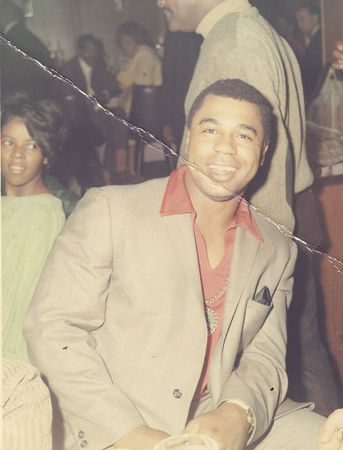
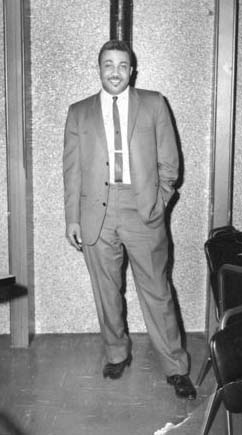
... when the times were toughest...
 Dad at Niagara Falls, 1950s
 Dad and Me, Detroit
 Photos by Jason Schmidt
  Well, I'm sitting in a Starbucks in Detroit because Ma has no Internet connection at the house. I got in yesterday. I guess it's a good thing. I'm ready to end my pilgrimages to Detroit for good. It's my hometown, but it depresses me to be here.
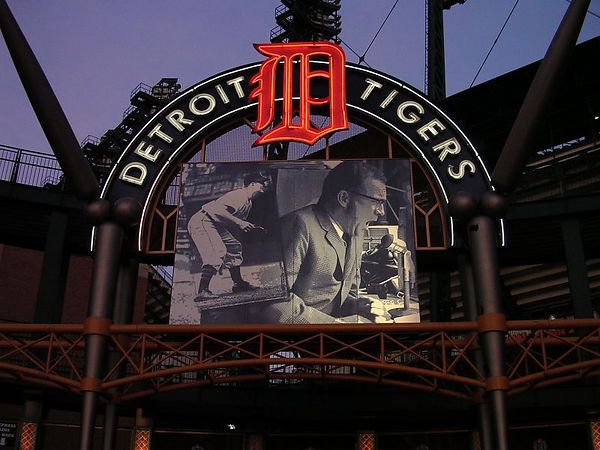 The Main Entrance to the Comerica Park, AKA Detroit Tiger Stadium
 Don't mess with me! I'll tear your heart out! I'm a tiger! Rooar!
 The first person I called on September 11, 2001 was my dad, Edward. This was, of course, after the initial hysteria of the day.



So, I'm sitting at the Chili's in LaGuardia Airport, chillin' with a cold Sam Adams and reading Rolling Stone. I'm also sitting here mobile blogging. Woohoo. My flight doesn't leave until 6:00 (it's 4:30 now), so I plan on having at least one more giant, cold, Sam Adams so that I'll be woozie on the plane.
I'm going home to see my dad, who underwent colon cancer surgery last month and is now undergoing radiation therapy by pill. Which, I think, means I'm going to have to talk to him through his bedroom door or don surgical scrubs, not quite sure which.
Anyway, this will be the first time I've been able to see him since the surgery last month.
If the parental units haven't pulled the plug on the Internet, I'll still be blogging, from a Detroit perspective.
Right now, however, Rolling Stone and Sam Adams are calling my name.
Drink me, says Sam; read me, says Rolling Stone; eavesdrop on the guy sitting next to me talking loudly about meeting President Clinton and Broadway shows... Priceless.
One of the cruelest aspects of slavery was the way it wrenched apart black families, separating husbands from wives and children from their parents.Herbert essentially says that many of the plights of blacks today are self-inflicted wounds, particularly "behavioral issues and the corrosion of black family life," and choosing to "wallow in a self-imposed ignorance," when it comes to the issue of education.
It is ironic, to say the least, that now, nearly a century and a half after the Emancipation Proclamation, much of the most devastating damage to black families, and especially black children, is self-inflicted.
You don't have to be Sherlock Holmes to know that some of the most serious problems facing blacks in the United States - from poverty to incarceration rates to death at an early age - are linked in varying degrees to behavioral issues and the corrosion of black family life, especially the absence of fathers.
Another devastating aspect of slavery was the numbing ignorance that often resulted from the prohibition against the education of slaves. It was against the law in most instances for slaves to even learn to read. Now, with education widely (though imperfectly) available, we have entire legions of black youngsters turning their backs on school, choosing instead to wallow in a self-imposed ignorance that in the long run is as destructive as a bullet to the brain.
The problems facing black people today are comparable in magnitude to those of the Jim Crow era of the 20th century. There were leaders in those days who were equal to the challenge. I believe that nothing short of a new movement, comparable in scope and dedication to that of the civil rights era, is required to bring about the changes in values and behavior needed to halt the self-destruction that is consuming so many black lives. The crucial question is whether the leadership exists to mount such an effort.
A good first step would be a summit meeting of wise and dedicated men and women willing to think about creative new ways to approach such problems as crime and violence, out-of-wedlock births, drug and alcohol abuse, irresponsible sexual behavior, misogyny, and so on.
Addressing issues of values and behavior within the black community should not in any way imply a lessening of the pressure on the broader society to meet its legal and ethical obligations. It should be seen as an essential counterpoint to that pressure. (emphasis added)
Most important, it should be seen as a crucial component of the obligation that black adults have to create a broadly nurturing environment in which succeeding generations of black children can survive and thrive.
Despite the sometimes valiant efforts of individuals and organizations across the country, we are not meeting that obligation now. And that's because there's a vacuum where our leadership should be.